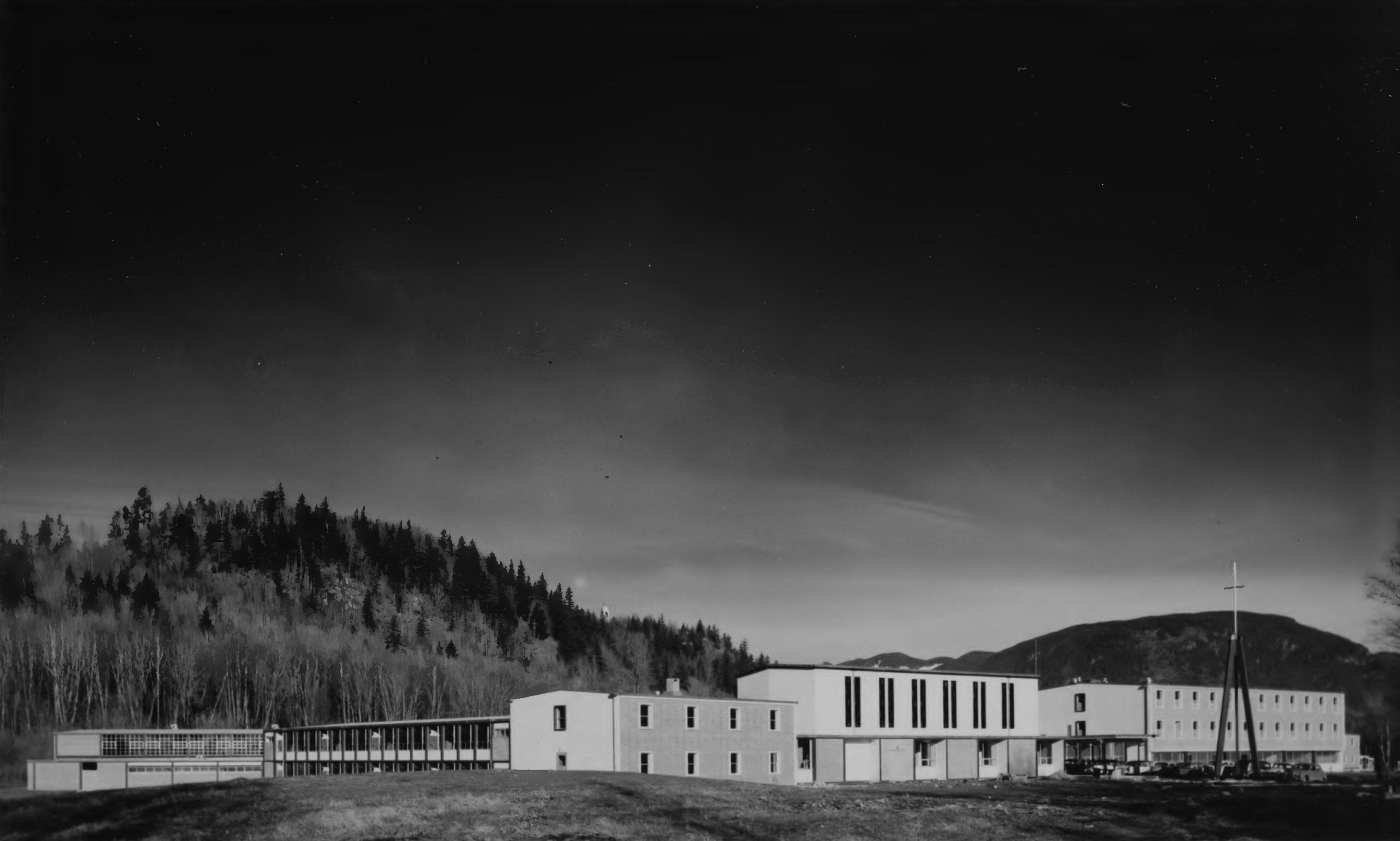
In 1961, St. Mary’s Residential School was rebuilt on a site overlooking the Fraser River in S’ólh Téméxw, the unceded and traditional territory of the Stó:lō. Its sparse, rectangular
volumes, arranged at irregular angles as if scattered on the landscape, contrasted with the dilapidated structures of the previous campus down the hill. Originally part of a Roman
Catholic mission from which the adjacent settler town of Mission, British Columbia, took its name, this school was where the Missionary Oblates of Mary Immaculate and Sisters
of St. Ann had worked to convert and assimilate Indigenous children for nearly a century.
This contribution to a roundtable essay on the architecture of Indigenous education looks at the continued Catholic influence on a new government-owned residential school built in an era of postwar secular reform. Edited by Anne Lawrason Marshall and Jason Tippeconnic Fox, the roundtable also includes contributions from Shawn Brigman, Anjelica S. Gallegos, James K. Bird, Christian Hart Nakarado, Melissa Rovner, Elisa Dainese, Karla Cavarra Britton, Johnpaul Jones, and Daniel J. Glenn.
Continue reading in Journal of the Society of Architectural Historians →
Photo: Gardiner Thornton Gathe & Associates, St. Mary’s Residential School, Mission, British Columbia, 1959–61, view showing (left to right) gymnasium, classroom block, priests’ house, chapel, and dormitory, with cross-topped bell tower in front of the main entrance (photo by John Fulker, Architectural Photography; Deschatelets-NDC Archives / National Centre for Truth and Reconciliation).

 Magdalena Miłosz